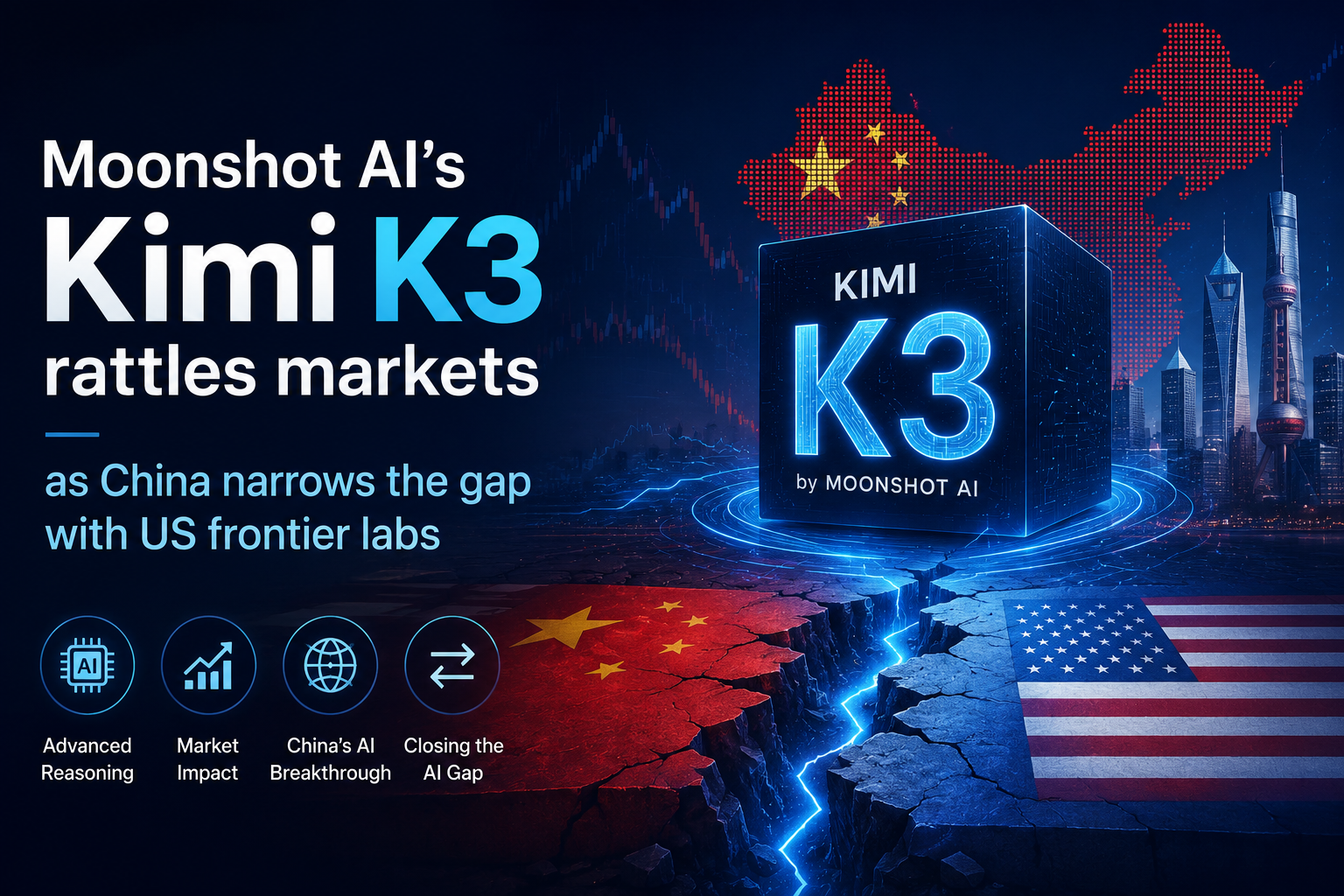
On July 17, 2026, Chinese startup Moonshot AI unveiled Kimi K3 at the World Artificial Intelligence Conference in Shanghai — a 2.8 trillion-parameter model that is, by parameter count, the largest AI system China has ever produced, and the first open-weight model to enter the three-trillion-parameter class once its weights are published on July 27.
The market reaction was immediate and loud. An estimated $314 billion was wiped from valuation estimates for OpenAI and Anthropic as investors drew comparisons to the DeepSeek moment of early 2025. Chinese competitors Zhipu, MiniMax, and Z.ai saw their Hong Kong-listed shares fall between 16% and 28% on the day of the announcement, and the Nasdaq dipped roughly 1% as chipmakers including Nvidia and Intel sold off in sympathy.
Here's what actually happened, what the benchmarks show, and why this release matters differently than the one it's being compared to.
What Is Kimi K3, Exactly?
Kimi K3 is an open-weight large language model built by Moonshot AI, backed by Alibaba and Tencent, and valued at over $20 billion following a $2 billion raise in May 2026. "Open-weight" means the underlying model parameters are published publicly — from July 27, any developer can download, run, modify, and self-host the model without paying for API access or relying on Moonshot's cloud infrastructure.
At 2.8 trillion total parameters, it's designed for coding, complex reasoning, knowledge work, and agentic tasks that require minimal human oversight — the kind of workflows increasingly central to enterprise AI deployment.
According to Moonshot's own published benchmarks, Kimi K3 trails Anthropic's Claude Fable 5 and OpenAI's GPT 5.6 Sol on overall performance. But it outperforms Claude Opus 4.8, GPT 5.5, and xAI's Grok specifically on coding and general agent benchmarks. Independent testing from Arena.ai went further, placing Kimi K3 first in web interface engineering in blind human-preference evaluations — meaning human testers, without knowing which model produced which result, rated its web development output above competing systems including Anthropic's.
The Efficiency Story Is More Interesting Than the Size
The headline number — 2.8 trillion parameters — makes Kimi K3 sound like a brute-force scaling play. The more technically interesting detail is what Moonshot did with sparsity.
A model's sparsity ratio measures how few of its total parameters actually activate for any given task relative to its full size. Kimi K3 pushes this ratio to a record high for a Chinese model, meaning it's more computationally efficient per task than its raw parameter count suggests. Bank of America analyst Alex Liu described this as evidence that Chinese AI labs can achieve "step-change gains" in capability even while working under continued US export restrictions on advanced chips.
But sparsity doesn't shrink the storage problem. Every one of those 2.8 trillion parameters still has to live in memory somewhere. Even compressed using lower-precision data formats, Kimi K3 occupies roughly 1.4 terabytes — meaning running it at scale still requires memory-dense hardware like Nvidia's Blackwell GB300 systems. That's a meaningfully different bet than DeepSeek's R1 release in early 2025, which was built around cutting training and inference costs directly. Kimi K3 gets more efficient per task, but it does so by getting bigger, not smaller — which is exactly why the memory and chip market reaction has been so pronounced, with continued demand implications for high-bandwidth memory makers like SK Hynix and advanced foundries like TSMC.
Is This Actually Another "DeepSeek Moment"?
The comparison to DeepSeek's R1 release is everywhere, but analysts are split on whether it holds up.
Patrick Moorhead, CEO and chief analyst at Moor Insights and Strategy, called the market reaction "an over-reaction shockingly similar to the DeepSeek panic," arguing that increasingly capable open-weight models like Kimi K3 will "accelerate and grow the inference market faster than without" — the opposite of the "AI needs less compute" fear that drove the original DeepSeek selloff.
Perplexity CEO Aravind Srinivas offered a framing that matters more for how enterprises should actually think about this: "The model alone is no longer the product. It is the harness, the orchestration system that puts the model inside a very capable harness and pairs the model with a lot of tools." As capable open-weight models proliferate, the competitive edge shifts away from which base model you're running and toward how well you've built the orchestration, governance, and integration layer around it.
Alibaba adding fuel to this narrative over the same weekend didn't help calm things — the company previewed Qwen 3.8-Max, a 2.4 trillion-parameter model reportedly performing alongside leading frontier systems, though without published benchmarks yet. China's tech-heavy ChiNext Index climbed as much as 3.6% on the combined news.
What This Means for Enterprise AI Strategy
For IT and AI procurement leaders, Kimi K3's arrival raises three concrete questions:
Is proprietary model pricing sustainable? A credible, free, frontier-class alternative changes the negotiating position enterprises have with OpenAI and Anthropic, regardless of whether organizations actually switch.
Is open-weight deployment viable at enterprise governance standards? Self-hosting a 1.4TB model is a genuinely different operational commitment than calling an API — data governance, security review, and infrastructure planning all look different.
How do national security considerations factor into model selection? This is not a minor footnote. US lawmakers are actively considering legislation to curb domestic adoption of Chinese AI models, and Ray Wang of Constellation Research has been direct that "national security issues remain around Chinese AI models." Any enterprise evaluating Kimi K3 needs to run that evaluation through existing security and compliance review, not treat it as a pure capability decision.
Lu Zhang, founder of Fusion Fund, noted that open-weight model adoption today skews heavily toward startups rather than large corporates — though she expects that gap to narrow as models get cheaper and more capable. Simon Koser, chief product officer at AI startup Tzafon, added a useful caution against overreacting to the benchmark headlines: "It's going to seem like a lot of people are changing. But in practice, I'm not sure if the shift is that huge." Benchmark performance doesn't always translate cleanly to production workloads, and no single model — Kimi K3 included — wins at every enterprise task.
The Bottom Line
Kimi K3 is the clearest signal yet that frontier-class AI performance is no longer exclusively the domain of expensive, closed US systems. It doesn't beat Claude Fable 5 or GPT 5.6 Sol outright, but it gets close enough — for free, with the weights published — that it materially changes the calculus for anyone budgeting for AI infrastructure over the next year.
The strategic question for enterprise teams isn't whether open-weight models have gotten good enough. It's whether your organization's governance, security review process, and AI orchestration layer are actually ready to evaluate and deploy something like this responsibly, if and when the capability case becomes compelling enough to act on.
Try Kimi Yourself
If you want to test Kimi's models directly rather than just read the benchmarks, Moonshot is currently running a referral promotion: sign up through an invite link and both the new user and the person who invited them receive guaranteed membership credits — up to a full year of membership depending on the promotion tier active at signup.
Disclosure: the link below is a referral link — using it supports Humbaa and gives you a welcome credit bonus as well. Try Kimi and claim your membership credits →
If you're comparing large language models more broadly, see our full breakdown of the best LLMs in 2026, or browse Humbaa's AI tools directory for tools built on top of models like these. If you've built an AI product yourself, you can submit it to Humbaa to reach people actively researching this space.