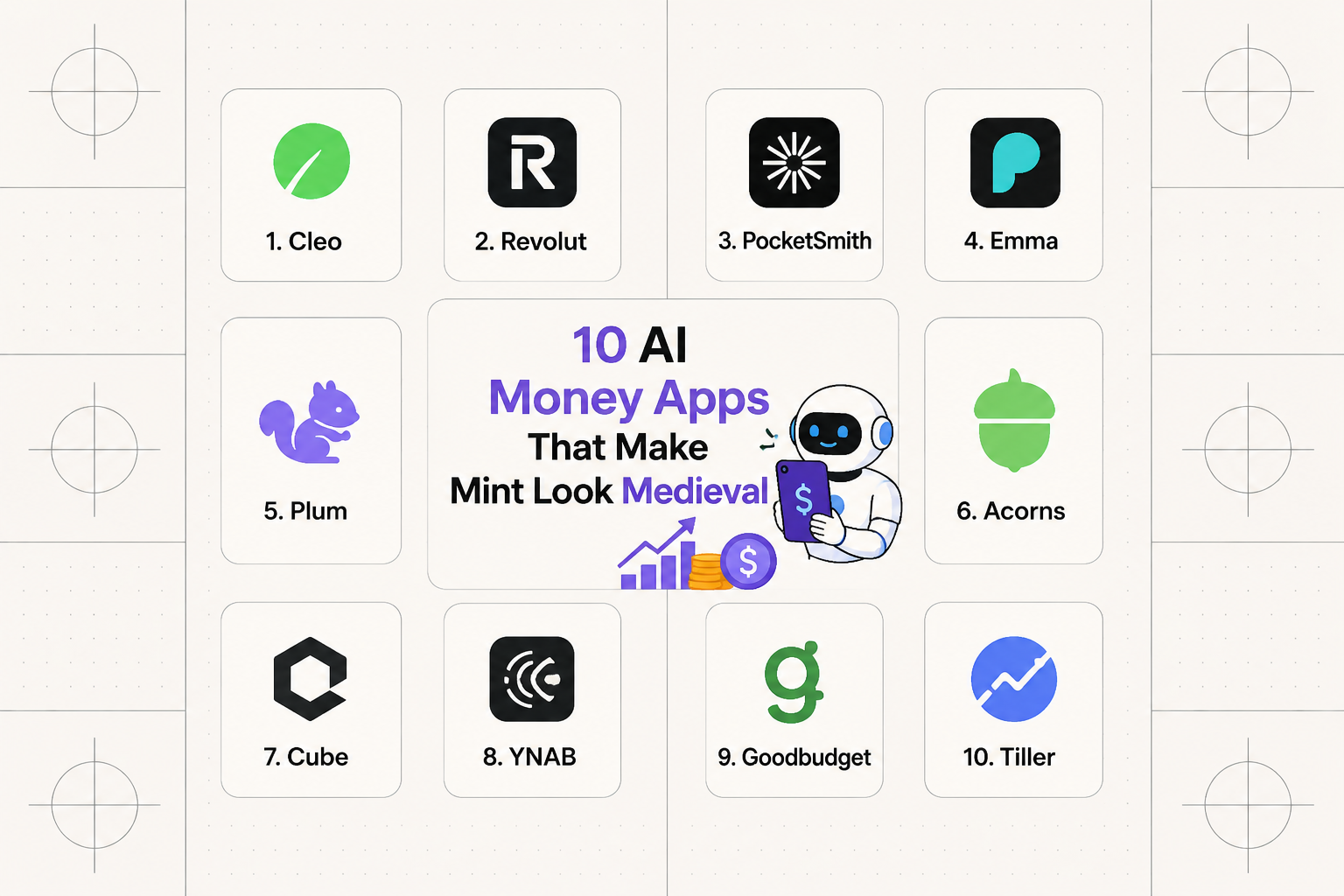
Personal finance apps went through a real shake-up after Mint's shutdown, and AI has quietly become the thing separating the apps that filled the gap from the ones that just moved the same spreadsheet into a nicer interface. Machine learning, predictive analytics, and conversational AI are doing genuinely new things in this category now — not just prettier categorization of your Starbucks habit.
We looked at where the established players stand, which AI-first platforms have actually pulled ahead, and what's coming up next in this space — plus the security considerations that matter more as these apps get deeper access to your financial life.
The Established Players Are Behind on AI
You'd expect the long-running names in personal finance to have kept pace with AI, but that's mostly not what happened.
YNAB remains a genuinely good product, but it only offers basic transaction categorization through automatic merchant recognition — and that's by design. YNAB deliberately favors manual, hands-on budgeting over automation, which is a legitimate philosophy for people who want control over every dollar. It just doesn't serve anyone looking for deeper AI-driven insight.
Empower (formerly Personal Capital) isn't much further ahead on the AI front — basic spending categorization, with its real strength being investment tracking. The free dashboard covers net worth monitoring and portfolio analysis well, but expect persistent sales calls pushing wealth management services that require a $100K minimum and charge 0.89% annually.
Quicken Simplifi, from the company that used to own Mint, covers spending, savings, investments, and net worth tracking competently, but its only real AI application is machine-learning-based transaction categorization — nothing close to predictive or conversational.
None of these three offer the features that define the current wave: predictive analytics, personalized financial guidance, anomaly detection, or genuine pattern recognition. That gap is exactly where the newer AI-first platforms have moved in.
The AI-First Platforms Leading the Category
Three platforms have emerged as the clearest leaders here, each taking a distinct approach to what "AI-powered finance" actually means.
Rocket Money
Rocket Money (formerly Truebill) built its reputation on finding and canceling subscriptions you forgot you were paying for, scanning linked accounts to surface recurring charges automatically. The company claims it's helped users save hundreds of millions collectively by killing unused subscriptions across more than 5 million users.
Its Smart Savings Autopilot studies your spending patterns to calculate how much you can realistically set aside, and its bill negotiation tool combines AI with actual human negotiators — reportedly saving users over $1 billion combined to date.
Key AI features: automated savings calculated from spending habits; AI-driven subscription detection and management
Pros: clean design and navigation; tracks net worth and credit score; strong subscription cancellation tooling; solid charts and reporting
Cons: premium tier gets pricey; investment tracking is weak; lacks traditional financial reports
Cleo
Cleo takes the conversational route — a chatbot that manages your money through plain-language chat, with personality modes like Roast and Hype that make budgeting feel less like a chore. It's built up over 5 million users and roughly $150 million in annual revenue by 2024, with particular traction among Gen Z users.
The AI tracks spending in real time, delivers instant feedback, and gamifies better habits — it can also offer small cash advances up to $250.
Key AI features: spending trend analysis to identify patterns; forward-looking financial predictions based on current data; tailored savings suggestions
Pros: free to use with optional paid tiers; genuinely engaging chatbot interface; fast, simple setup
Cons: free version lacks the deeper features; premium pricing details are less transparent than they should be
Albert
Albert combines AI-driven automation with actual human financial experts through its Genius service — a hybrid model rather than a pure AI play. It's tracked more than 50 million transactions across over 10 million users, with its Smart Money Algorithm building custom budgets, automating savings, and assisting with investing.
The $14.99/month subscription includes early paycheck access, identity protection, and 24/7 access to human advisors, plus cash advances up to $250.
Key AI features: smart money transfers that move small amounts into savings without disrupting your budget; automatic spending categorization; AI-driven bill and subscription detection; real-time financial health monitoring across accounts
Pros: comprehensive feature set spanning budgeting, saving, investing, and identity monitoring; high-yield savings APY well above the national average; 30-day free trial; 24/7 fraud and identity protection
Cons: full feature access requires a subscription; some users report friction canceling or accessing funds; support leans heavily on text-based channels and can be slow
Emerging Tools Worth Watching
A newer wave of AI finance tools is pushing further into genuinely differentiated territory. A few worth tracking:
Monarch Money was named Best Budgeting App in 2024 by both The Wall Street Journal and Forbes, and connects to more than 13,000 financial institutions — the widest coverage of any app in this category. Its AI sorts transactions, forecasts future cash flow, and flags recurring subscriptions, with free account sharing for couples and a loyal 30,000+ member Reddit community behind it.
Copilot Money is an Apple-ecosystem favorite and one of the more popular Mint replacements among iPhone users. It learns spending habits over time, pulls supplementary data from sources like Amazon and Venmo, integrates with Google Sheets, and runs $13/month across Mac, iPhone, and iPad.
Tendi.ai is built entirely around AI from the ground up — trained specifically to outperform GPT-4 on the CFP (Certified Financial Planner) exam. It generates a custom Financial Health Score from 0–100 for each user, then builds budgets and challenges aimed at improving that score over time.
PocketGuard focuses on spending, debt, and net worth management with strong transaction tracking. Its AI features — including Quantra and automatic bill detection — are built specifically to simplify the budgeting process rather than add complexity.
The Security Trade-Off Worth Understanding
As AI becomes standard in personal finance apps, the security stakes rise with it. Nearly 42% of recent fintech data breaches have traced back to third-party vendors — the Finastra breach in late 2024 alone leaked roughly 400GB of customer data onto dark web forums. AI introduces its own additional risk surface too: poisoned training data, attacks designed to extract private information, and models that are genuinely difficult to audit for bias.
A few concrete safeguards worth adopting before connecting any AI finance app to your accounts:
- Enable multi-factor authentication wherever it's offered
- Limit how many accounts you actually connect — link only what you need
- Avoid finance-related activity over public Wi-Fi
- Look for recognized security certifications: SOC 2 Type II, ISO 27001, or PCI DSS Level 1
- Prefer apps that authenticate via OAuth rather than asking you to hand over your bank username and password directly
Which One Should You Actually Use?
If you're budget-conscious: Cleo's free chat-based advice or Tendi.ai's personalized Financial Health Score are strong starting points with minimal upfront cost.
If you want hands-off management: Monarch Money's 13,000+ bank connections or PocketGuard's automated "In My Pocket" savings feature both do the heavy lifting for you.
If you're fully in the Apple ecosystem: Copilot Money is built specifically for that experience across Mac, iPhone, and iPad.
If you want AI plus real human backup: Albert's Genius service pairs its algorithm with 24/7 access to actual financial advisors.
If forgotten subscriptions are draining your account: Rocket Money's automated detection and cancellation tooling routinely saves users a couple hundred dollars a year without much effort on your end.
If privacy is your top priority: favor apps with explicit no-data-selling policies, recognized security certifications, and a clean breach history — and review connected-account permissions periodically regardless of which app you choose.
AI has stopped being a gimmick bolted onto personal finance apps and become the actual mechanism millions of people use to budget, save, and plan. The tools above represent where that shift currently stands — the right pick depends less on which has the most features and more on which fits how you actually want to manage money day to day.
If you're building or comparing AI-powered fintech tools, Humbaa's AI tools directory is worth browsing for adjacent categories like budgeting, investing, and productivity software. And if you've built a tool in this space, you can submit it to Humbaa to get in front of people actively evaluating AI finance apps like the ones covered here.