There's no shortage of keyword research tools out there — hundreds of them, ranging from beginner-friendly to genuinely overbuilt for casual use. Some are basic to the point of being useless; others give you more data than you'll ever need without charging enterprise prices to get it.
A good keyword research tool should simplify the actual workflow — surfacing the right keywords to target and the data you need to realistically rank for them — without requiring a paid plan just to see anything useful. We compared free-tier keyword research tools across data depth, usability, and how generous the free plan actually is, and landed on five that are genuinely worth using in 2026.
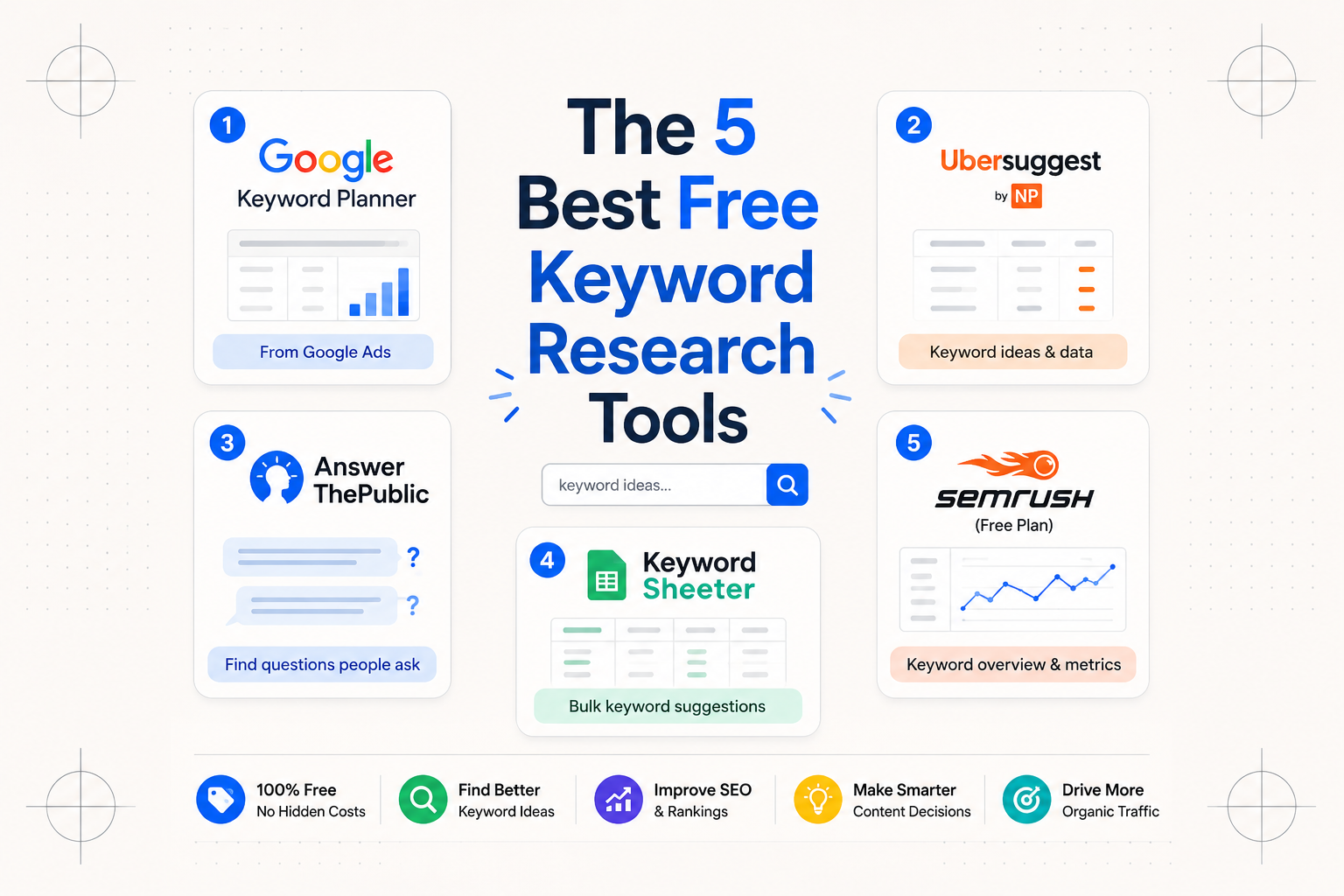
The Best Free Keyword Research Tools at a Glance
| Tool | Best For | Standout Feature | Free Plan |
|---|---|---|---|
| Google Keyword Planner | Researching paid keywords | Forecasting features and budget planning | Completely free (more useful with a Google Ads account) |
| Semrush | Advanced SEO professionals | Granular keyword data | 10 Analytics reports/day, 10 tracked keywords |
| KWFinder | Ad hoc keyword research | Keyword opportunity identification | 5 searches/day |
| AnswerThePublic | Content marketing | Flywheel keyword visualization | 3 searches/day |
| Allintitle KW Explorer | Ad hoc research beyond Google search | Source filtering for non-Google SERP data | 10 tokens/month |
What Makes a Genuinely Good Keyword Research Tool?
The core function of any keyword tool is simple on paper: search a term, get data back about it. The differentiation comes from how much data, how usable it is, and whether the free tier is actually a free tier — not a disguised trial. Here's what separates the tools worth using from the ones that aren't:
- Real data depth — at minimum, traffic volume, keyword difficulty, and competitive SERP analysis, not just a single vague number
- Actionable optimization guidance — you shouldn't need a decade of SEO experience to interpret the output; the best tools translate raw data into a next step
- A genuinely evergreen free plan — not a time-boxed trial disguised as "free," and generous enough to be useful on its own
- Standalone functionality — a free keyword tool shouldn't require additional paid tools or browser extensions just to be usable
1. Google Keyword Planner — Best for Paid Keyword Research
Free plan: Completely free, forever — no account required, though it's more useful if you're running Google Ads
Google Keyword Planner remains one of the strongest tools available for PPC-focused keyword research, and the fact that it's entirely free — even without an active Google Ads account — makes it hard to skip regardless of what else you're using.
It's built around two core functions. The Keyword Ideas feature works like most tools on this list: enter a seed term and get related keyword suggestions back, along with monthly search volume, change over time, competition level, ad impression share, and bid ranges. You can refine results by brand versus non-brand terms, source website, and other filters. If you are running Google Ads, the Forecast feature helps plan budget and expected performance ahead of a campaign.
It's also useful beyond pure PPC — Keyword Planner can surface opportunities where ranking organically would let you reduce paid ad spend on a given term, making it a reasonable complement to organic strategy even if paid search isn't your main focus.
Pros: free forever regardless of ad spend; strong forecasting and budget-planning tools; can pull suggestions directly from your own site
Cons: less useful specifically for organic keyword research compared to dedicated SEO tools
2. Semrush — Best for Advanced SEO Work
Free plan: Up to 10 Analytics reports per day, 10 tracked keywords
Semrush is the deepest tool on this list by a clear margin, offering granular keyword data alongside genuinely detailed SERP feature breakdowns — AI overviews, knowledge panels, review snippets, site links, image packs, and more.
What sets Semrush apart is breadth: the standard Keyword Overview report, the Keyword Magic Tool for exploratory research, a Keyword Manager with position tracking, competitive Keyword Gap analysis, a keyword cannibalization report, and Organic Traffic Insights — which, connected to Google Analytics or Search Console, can help surface the notoriously opaque "not provided" keyword data Google normally withholds.
Two extras push it further: the SEO Content Template tool auto-generates a content brief from your target keywords, and the SEO Writing Assistant grades content in real time for readability, originality, tone, and SEO strength using a bullseye-style visual, checking off recommendations like target keyword usage and internal linking as you write.
Pros: extremely granular keyword data; broad range of specialized research tools beyond basic search; genuinely usable free tier to start
Cons: can overwhelm less experienced users; the most expensive upgrade path on this list
3. KWFinder — Best for Ad Hoc Keyword Research
Free plan: 5 searches per day
If you don't need daily, high-volume keyword research, KWFinder's tight daily limit is less of a drawback than it sounds — each individual search returns a genuinely large amount of data.
Standard metrics are all here: monthly search volume, keyword difficulty, related keywords, and a breakdown of who's currently ranking for the term. What makes KWFinder distinctive is a set of less common but genuinely useful details — searcher intent classification per keyword, and the content format currently dominating the SERP (listicle, homepage, blog post, product page).
The standout feature is the keyword opportunities column, which flags weaknesses in the current page-one results and suggests how to outrank them — for example, identifying when top-ranking pages are outdated (older than six months) or missing the exact target keyword in their meta title.
KWFinder is part of the broader Mangools SEO suite, which bundles other tools with limited free access, including a SERP simulator, AI search grader, and SEO content optimizer.
Pros: large amount of data per search despite the daily cap; unique opportunity-identification feature; access to a broader SEO toolkit
Cons: capped at 5 searches per day
4. AnswerThePublic — Best for Content Marketing
Free plan: 3 searches per day
Normally a 3-search daily cap would rule a tool out entirely, but AnswerThePublic packs enough into each search to be worth the limitation — particularly for anyone blending traditional SEO with AEO/GEO (answer-engine and generative-engine optimization).
Its standout is a flywheel-style visualization that presents keyword ideas in a genuinely easy-to-parse graphic format, rather than a plain list. By default, results span AI, search engines, social media, and shopping, each accessible via its own tab.
The AI Models tab summarizes search intent across leading AI models, with its own flywheel breakdown and a table of related prompts. The Search Engines tab shows standard monthly search volume and CPC data, followed by the same flywheel visualization broken down by keyword type — related terms, questions, prepositions, alphabetical variants, and numerical modifiers — before the familiar keyword list. Content Studio adds the ability to generate content directly from any keyword in a report using AI.
Pros: genuinely unique, digestible way to visualize keyword ideas; covers AI search intent alongside traditional search; reasonable upgrade cost
Cons: the tightest daily search limit on this list
5. Allintitle KW Explorer — Best for Research Beyond Google Search
Free plan: 10 tokens per month (roughly 10 bulk searches or 5 uses of the Keyword Explorer tool)
Allintitle is a solid pick for infrequent keyword research needs, and it doesn't require account creation to use. Despite the token-limited free tier, it returns a genuinely large data set per search — including content optimization suggestions and keyword gap analysis — with flexible pay-as-you-go or monthly upgrade paths once you outgrow the free allowance.
All the expected metrics are present — keyword difficulty, search volume, LSI keywords, SERP overview — but what actually differentiates Allintitle is how easily it extends keyword research beyond a standard Google SERP. Running a Keyword Explorer search shows the distribution of results across source platforms, and the Related Keywords tab lets you filter by source directly — surfacing top keywords specifically from Amazon, eBay, YouTube, TikTok, and Perplexity.
Pros: genuinely useful for non-Google-SERP keyword research; no account required to start; flexible upgrade structure
Cons: the monthly token allowance is limiting for anything beyond occasional use
Can AI Chatbots Do Keyword Research Instead?
You can absolutely ask ChatGPT or Claude to do keyword research directly, and for basic, ad hoc needs, the results tend to be genuinely usable — a simplified, conversational answer that covers what a quick research task requires. Both tend to return more useful, precise-feeling data with less back-and-forth than Google's own Gemini currently manages for this specific task.
The advantage chatbots have that dedicated tools don't: you can refine and iterate conversationally until the answer actually fits what you're looking for, rather than running a fresh search from scratch each time.
That said, chatbots aren't purpose-built for this. They lack the specialized tooling dedicated platforms offer out of the box — detailed SERP overviews, keyword gap analysis, rank tracking over time — and their numerical data tends to be less precise than what a dedicated tool like Google Keyword Planner or Semrush returns. There's also no clean, persistent way to track researched keywords across sessions unless that's the only thing you're using the chatbot for.
For serious, ongoing keyword work, a dedicated tool is still the stronger choice — but for genuinely one-off research, the gap between a chatbot and a purpose-built tool has narrowed enough that it's mostly a matter of preference now. Worth noting: several paid SEO tools now bundle AI directly into the platform, which is arguably the best of both approaches.
When Should You Actually Upgrade From a Free Plan?
Short answer: only when you genuinely need to. If a free tier covers what you actually need, there's no reason to pay for more.
That said, a few signs it's time to consider upgrading:
- You're consistently hitting your tool's daily or monthly search limits
- You're missing features locked behind the paid tier — content optimization guidance, ongoing rank tracking, and similar tools
- You need broader SEO functionality an all-in-one platform can provide, like technical site auditing
The tools above are built to scale with you when that moment comes — several offer clear upgrade paths rather than forcing a switch to an entirely different platform once the free tier stops being enough.
If you're comparing SEO, marketing, or content tools more broadly, browse Humbaa's AI tools directory for adjacent categories worth checking out. And if you've built an SEO or marketing tool yourself, you can submit it to Humbaa to reach people actively comparing tools like the ones above.